Do Insurance Companies Pay for ADAS Calibrations?
Insurance companies often pay for ADAS calibrations when they are necessary as part of a covered repair—but reimbursement depends on demonstrating why the calibration was required and providing supporting documentation.
Posted: June 9, 2026
Author: Jaden Shah
Introduction
ADAS calibrations have become one of the most discussed topics in modern collision repair. As vehicles become increasingly dependent on cameras, radar sensors, and other advanced safety systems, repair facilities are performing more calibrations than ever before.
At the same time, many shops are asking the same question: do insurance companies pay for ADAS calibrations?
The short answer is yes—insurance companies often pay for ADAS calibrations when they are necessary as part of a covered repair. However, receiving reimbursement typically depends on a shop's ability to demonstrate why the calibration was required and provide supporting documentation.
For repair facilities, understanding how ADAS calibrations fit into the claims process is becoming just as important as understanding the calibration procedures themselves.
Why ADAS Calibrations Matter
Modern vehicles rely on Advanced Driver Assistance Systems (ADAS) to support driver awareness and vehicle safety. Features such as Automatic Emergency Braking, Adaptive Cruise Control, Blind Spot Monitoring, Lane Keep Assist, and Forward Collision Warning all depend on sensors being positioned and calibrated according to manufacturer specifications.
Even relatively common repairs can affect these systems. Operations such as windshield replacement, bumper repairs, suspension work, wheel alignments, and structural repairs may require one or more ADAS calibrations before the vehicle can be returned to the customer.
Because these systems directly impact vehicle safety, manufacturers publish procedures outlining when calibrations are required and how they must be performed. The goal isn't simply to repair the vehicle—it's to restore the safety systems to their intended operating condition.
The Insurance Perspective
From a repair facility's perspective, a calibration may seem straightforward. If the OEM procedure says it's required, the work gets performed.
Insurance carriers, however, approach the process differently. Their job is to verify that the operation is related to the loss, supported by repair procedures, and billed appropriately. When a calibration charge appears on an estimate or invoice, reviewers often need to understand:
- Why the calibration was necessary
- What repair operation triggered the requirement
- Whether OEM guidance supports the procedure
- Whether the calibration was actually completed
In many cases, insurance companies are willing to pay for ADAS calibrations. The challenge is helping them understand why the operation belongs on the repair.
Why Some ADAS Calibration Charges Get Challenged
When calibration-related charges are questioned, it is often because information is missing—not because the calibration itself was unnecessary. Common issues include:
- Missing OEM documentation
- Incomplete repair records
- Unclear calibration requirements
- Missing scan reports
- Poorly itemized estimates
- Lack of supporting documentation
For example, if a shop performs a camera calibration following a windshield replacement but cannot quickly demonstrate the manufacturer's requirement, an insurer may ask for additional information before approving the charge. These situations can lead to delays, administrative work, and frustration for everyone involved.
OEM Documentation Plays a Critical Role
One of the strongest ways to support an ADAS calibration charge is through OEM repair information. Manufacturers determine when calibrations are required. Their procedures explain what conditions trigger those requirements and how the calibration should be performed.
Because requirements vary significantly between manufacturers and vehicle models, relying on assumptions can create unnecessary risk. This is why many repair facilities now place a greater emphasis on accessing OEM service information as part of their repair planning process.
When a shop can clearly connect a repair operation to a manufacturer's calibration requirement, reimbursement discussions often become much more straightforward.
What Insurers Want to See
Insurance reviewers generally want clear, organized information that helps them understand the repair. This may include:
- Vehicle information
- Identified ADAS systems
- Required calibrations
- Supporting OEM documentation
- Calibration reports
- Scan results
- Technician or provider information
The easier it is for a reviewer to follow the story of the repair, the easier it becomes to evaluate the claim. This is one reason many repair facilities are moving away from manual documentation processes and toward standardized reporting workflows.
How ADAS Find Helps Support Reimbursement
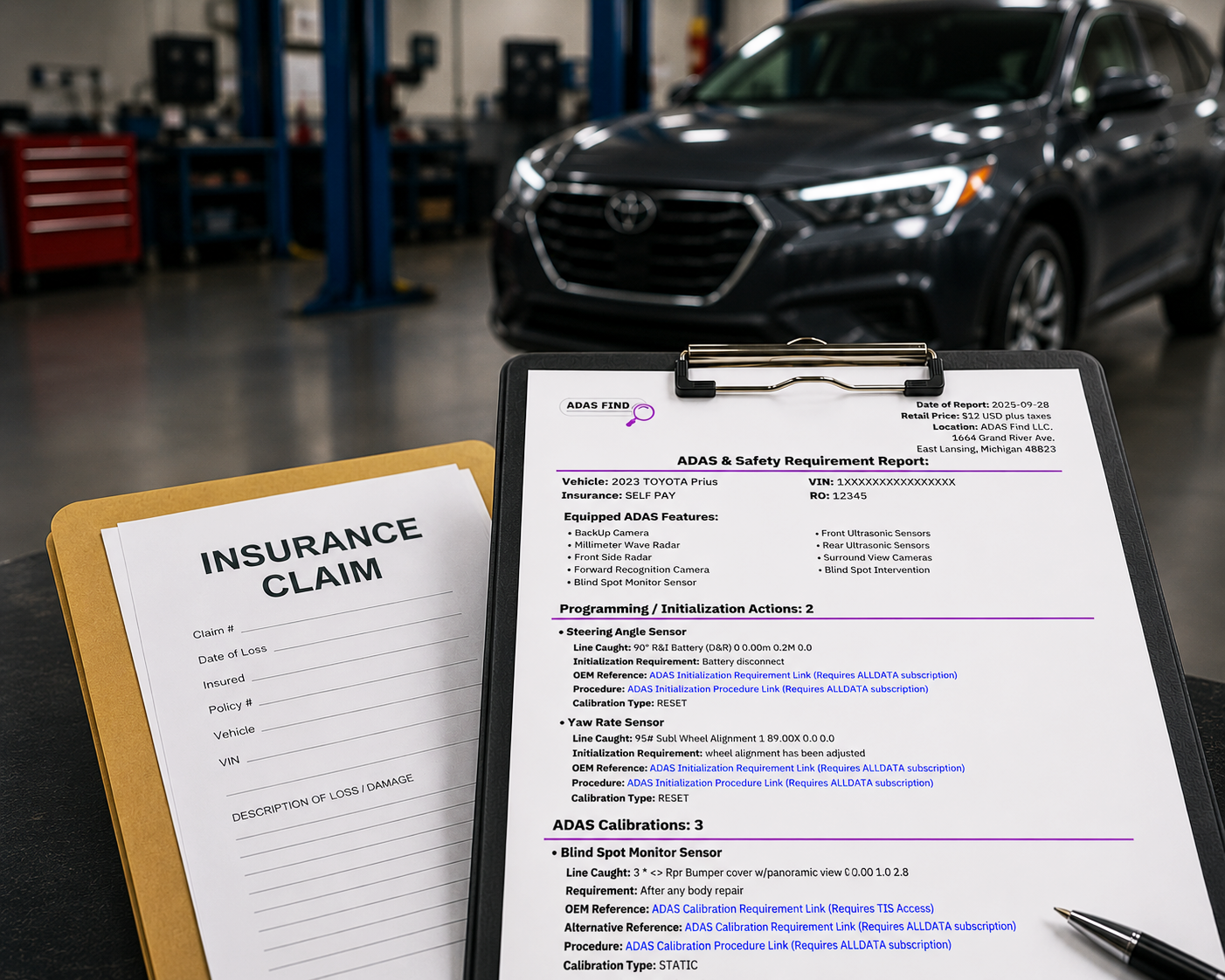
ADAS Find was built to help repair facilities simplify one of the most challenging parts of the ADAS process: identifying requirements and documenting them properly. Instead of spending valuable time searching through multiple systems, shops can use ADAS Find to:
- Identify required ADAS calibrations
- Access supporting OEM documentation
- Generate professional insurance-ready reports
- Track technician activity and completed work
- Maintain organized repair records
By connecting calibration identification directly to OEM information, ADAS Find helps repair facilities create documentation that clearly explains why a calibration was necessary. This not only improves internal consistency but also helps provide insurers with the information they need to review and approve ADAS-related operations.
The Future of ADAS Reimbursement
The number of vehicles equipped with ADAS technology continues to grow every year. As these systems become more sophisticated, calibrations will become an increasingly common part of the repair process.
At the same time, insurers will continue looking for clear justification behind calibration-related charges. Shops that establish strong processes for identifying calibration requirements, accessing OEM procedures, and documenting completed work will be better positioned to protect revenue and reduce reimbursement challenges.
Final Thoughts
So, do insurance companies pay for ADAS calibrations? In many cases, yes. But successful reimbursement often depends on more than simply performing the calibration. Shops must be able to demonstrate why the operation was required, connect it to OEM guidance, and provide documentation that supports the repair.
As ADAS-equipped vehicles become the norm, the facilities that consistently get paid for calibration-related work will be the ones that can clearly tell that story. ADAS Find helps shops do exactly that by combining ADAS calibration identification, direct OEM documentation access, insurance-ready reporting, and technician accountability into a single platform. By making it easier to identify, document, and communicate calibration requirements, ADAS Find helps repair facilities strengthen reimbursement support while delivering safer, more complete repairs.